A life for a life
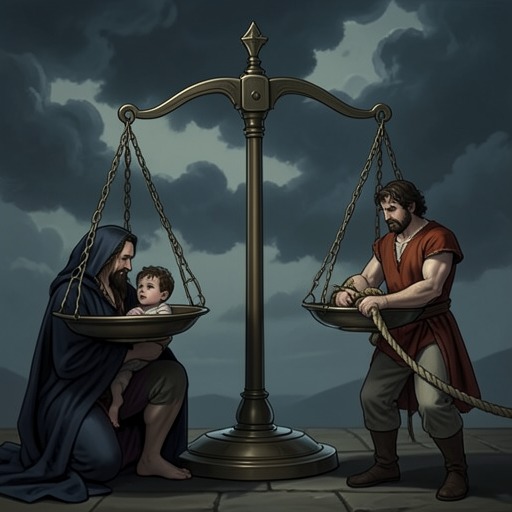
A Court of Thorns and Roses“A life for a life” is the Treaty’s stark exchange principle: when a human launches an unprovoked attack on faerie-kind, a human life must be surrendered in return. In Feyre Archeron’s first encounter with the beast, the expression transforms an apparently personal abduction into the enforcement of an inter-realm law, while making the cost of compliance inseparable from the survival of her family.
Definition and Legal Force
The rule is stated plainly by the beast after Feyre Archeron asks what payment the Treaty requires. He explains that any unprovoked human attack on faerie-kind is to be paid only by a human life in exchange. The wording establishes both the penalty and its limit: the required payment is a human life, and the triggering act must have been unprovoked. Because faeries cannot lie, the beast’s explanation carries the force of an unambiguous legal disclosure rather than a deceptive threat or verbal trick.
The law also reveals that the Treaty governs relations between humans and faeries through direct equivalence. A death committed by a human does not remain an isolated crime; it activates a reciprocal demand upon the human world. The expression therefore functions simultaneously as a rule, a sentence, and a justification for removing a human from her home.
The Circumstances of Its Invocation
The rule is invoked because a mercenary in town killed a faerie, though the faerie had attacked him first. Feyre Archeron realizes that she did not know this part of the Treaty, and the correction matters: the law is not presented as authorizing every retaliatory killing, but as distinguishing an unprovoked attack from an act of self-defense. The beast’s demand is consequently tied to the specific circumstances of the faerie’s death rather than to a general hatred of humans.
Feyre Archeron asks about the payment while facing the beast with her remaining knife. Her question is an attempt to understand the terms governing the danger before her, but the answer removes any comforting ambiguity. The exchange has already reached her household: the payment will not be abstract, and the human life demanded will be hers.
Family, Sacrifice, and Choice
The phrase acquires its deepest emotional force when Feyre Archeron considers what her departure means for the people left behind. She recognizes that Nesta Archeron would fight to buy Elain Archeron time to escape, while neither their father nor Feyre Archeron would receive the same protection from Nesta Archeron. Elain Archeron’s gentleness makes her the sister Nesta Archeron would defend most fiercely, and this understanding redirects Feyre Archeron’s fear toward the consequences of refusing the bargain.
Her father’s farewell intensifies the conflict. He tells Feyre Archeron never to return, urging her to go somewhere new and make a name for herself, but the expression reframes those words as the beginning of a loss that will affect three other lives. Feyre Archeron thinks that a life offered as payment may also mean losing three others. The rule thus creates a cruel arithmetic in which one person’s surrender is both a deathly cost and, in her judgment, the condition for her family’s continued safety.
Consequence and Narrative Significance
“A life for a life” converts fear into decision. Once Feyre Archeron understands the Treaty’s requirement, the thought of the consequences steels and anchors her; she leaves rather than allowing the beast to claim another path to her family. She follows him through the snow into the night-shrouded woods, making the legal formula the immediate cause of her passage from the human world into the faerie world.
The expression also establishes a recurring moral structure for the story: survival is purchased through binding exchanges, and every protection carries a corresponding cost. In this scene, the rule’s apparent simplicity conceals the emotional complexity of sacrifice. The law names one life as payment, but Feyre Archeron experiences that payment as a threat to an entire family. Its decisive narrative effect is therefore not merely to punish a prior death, but to force Feyre Archeron into an irreversible choice in which love, duty, and self-preservation become the same act.